Although more than 50 diseases caused by different biotic factors have been reported in pearl millet in India but only few are important. These are downy mildew, smut, ergot, rust and blast. These diseases directly reduce grain yield by affecting grain formation. In addition ergot can also reduce grain quality.
Use of resistant cultivars is the most cost-effective method of the control of pearl millet diseases. Following good understanding of epidemiology of diseases, screening techniques have been developed which easily differentiate between resistant and susceptible genotypes. Several selections from germplasm accessions have shown a high degree of stability for resistance across sites and years. The identified sources of resistance were effectively utilized in developing downy mildew resistant male-sterile lines and pollinators at AICPMIP centres. Moreover mutation-induced resistance was also successfully utilized. The residual variability for downy mildew resistance could also be exploited to improve the resistance levels of susceptible material.
Development of molecular tools has made it possible to use marker-assisted selection (MAS) to improve downy mildew resistance in pearl millet. Several putative quantitative trait loci (QTL) have been identified that determine a significant proportion of downy mildew resistance in pearl millet. Downy mildew resistant version of an early maturing hybrid HHB 67 has been recommended for release as HHB 67-2 in the state of Haryana. The parental lines of the original hybrid were improved for downy mildew resistance through marker-assisted as well as conventional backcross breeding programmes. The gene for downy mildew resistance was added to the male parent, H 77/833-2, through marker-assisted breeding using elite parent ICMP 451 as the resistance gene donor. The gene for downy mildew resistance was added to the female parent, 843A/B, from downy mildew resistant source ICML 22 through conventional backcross breeding. The All India Coordinated Pearl Millet Improvement Project (AICPMIP) conducted the field-testing of the new hybrid at various locations.
Management of Pearl Millet Diseases
Downy mildew [ Sclerospora graminicola (Sacc.) Schrot]
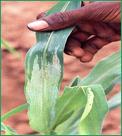 Downy mildew is widely distributed in all the pearl millet growing area in the world. Systemic symptoms as chlorosis generally appear on the second leaf and all the subsequent leaves and panicles of infected plant show symptoms. Leaf symptoms begin as chlorosis at the base of the leaf lamina and successively higher leaves show a progression of greater leaf area coverage by the symptoms. Infected chlorotic area produce massive amount of asexual spores, generally on the lower surface giving the leave a ‘downy’ appearance. Systemically infected plants remain stunted either do not produce panicle or produce malformed panicles. In many affected plants ‘green ear’ symptoms appear on the panicles due to the transformation of floral parts into leafy structure that may be total or partial and such plants do not produce seed or produce very few seeds. The infected leaves produce sexual spores (oospores) in the necrotic leaf tissue
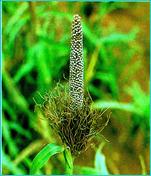 late in the season.
Currently in India about 50% of the 9 million ha under pearl millet cultivation is grown with more than 70 hybrids in which DM incidence has been highly variable, with some hybrids showing more than 90%incidence at farmer’s field. This disease can assuming alarming levels when a single genetically uniform pearl millet cultivar is repeatedly and extensively grown in a region. Yield losses within the region can reach 30-40%.
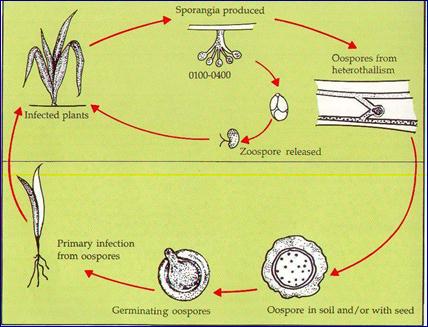
Life cycle of Sclerospora graminicola (Source: ICRISAT)Screening techniques
Highly effective field and greenhouse screening techniques that can easily and precisely differentiate between resistant and susceptible progenies have been developed for pearl millet diseases and 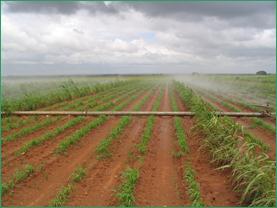 are being used extensively world wide.In field screening technique for downy mildew both sporangia and oospores are used as source of inoculum, the former being predominant. High humidity is necessary for spore production, spore dissemination and the infection process. This technique involves sowing of susceptible infector genotypes, test materials and a range of indicators in oospore infested fields, and scoring disease incidence at 30 and 60 days after sowing. Infector rows are mixtures of two or more susceptible genotypes, which are sown at regular intervals (every fifth or ninth rows) three weeks before planting the test materials. At 1-2 leaf stage, these infector rows are inoculated with a sporangial suspension during evening. Materials to be screened are sown in the intervening rows after the infector rows have 50-60% downy mildew incidence. High relative humidity is necessary for spore production and infection process, can be provided by sprinkler, perfo or furrow irrigation.
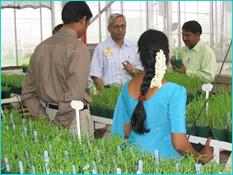 In greenhouse techniques, the potted seedlings are inoculated at the coleoptile to one-leaf-stage either by putting a drop of sporangial suspension (1x10⁶ sporangia/ml) at the tip of each seedling or by spray inoculation using a hand sprayer in an inoculation chamber maintained at 20oC and >95% relative humidity with freshly prepared, chilled (0-4 oC) sporangial suspension and the pots are incubated overnight in this chamber. Pots are than kept on greenhouse benches at 25-30oC.
Management
The diseases of pearl millet can be best controlled by integrating methods of chemical or biological control, and cultural practices.
- Use of resistant cultivars
- Rotate hybrids with variety alternately to keep soil inoculum under control.
- Seed treatment with Apron 35 SD @ 6g/kg seed
- Seed treatment with Bacillus pumulis (INR7)
- Seed treatment with Chitosan 10g/kg seed
- Foliar spray of Ridomil 25 WP (100 ppm) after 21 days of sowing if infection exceeds 2-5 %
- Rogue out infected plants and bury or burn
- Seed treatment with Ridomil MZ-72 @ 8g/kg seed and a foliar spray of Ridomil MZ-72 2g/l.
Rust [Puccinia substriata var. penicillariae. (Zimm.)]
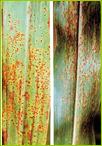
Rust symptoms first appear on lower leaves as typical pustules containing reddish brown powder (uredospores). Later, dark brown teliospores are produced. Symptoms can occur on both upper and lower surface of the leaves but mostly on upper surface and also on stem. Highly susceptible cultivars develop large pustules on leaf blades and sheaths.
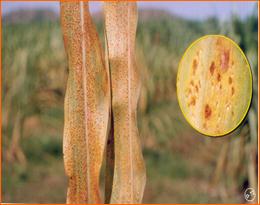 Rust has generally been considered as a relatively less important disease in most of the pearl millet growing areas than downy mildew, ergot and smut because of its appearance, generally after the grain-filling stage, causing little or no loss in grain yield. Worldwide this disease is probably of greater importance of multicut forage hybrids where even low rust severities can result in substantial losses of digestible dry matter yield.
Screening techniques
- Spray uredospores collected from infector rows, on 25-30 days old crop, twice, at 25 and 35 days after sowing.
- Spreading of uredinia-bearing leaves among test plants 25-30 days old.
Management
- Use of resistant hybrids/verieties.
- Sow the crop with the onset of monsoon.
- Destruction of collateral hosts like Ischaemum pretosum and Panicum maximum on the field bunds.
- Dusting of fine sulphur @ 17kg/ and two sprays of 0.2% Mancozeb at 15 days intervals
Smut [Moesziomyces penicillariae (Bref.)]
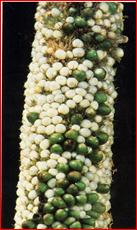
Smut disease is of greater importance in India especially with the adaptation of hybrids. The disease is more severe in CMS-based single-cross hybrids than in open-pollinated varieties. The infected florets produce sori that are larger than grains and appear as oval to conical, which are initially bright green but later turn brown to black. The estimated grain yield loss due to smut is 5-20%. The disease occurs during the month of September/ October. Early sown crop generally escapes from the smut infection.

Life cycle of Moesziomyces penicillariae fungus (Source: ICRISAT)
Screening techniques
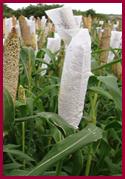
- Inoculation of panicles by injecting aqueous suspension of sporidia (1x10⁶/ml) in boot.
- Covering the inoculated panicles with parchment paper/ selfing bags.
- Providing high humidity(>80% RH) by using an overhead sprinkler, normally twice a day,30 min each at 10 am and 5 pm on rain-free days
- Removing bags 15-20 days after inoculation and scoring panicles for smut severity using a standard smut severity assessment key.
Management
- Use of resistant cultivars.
- Spray with Captafol followed by Zineb on panicle at boot leaf stage which reduces infection.
- Remove smutted ears from the field.
Ergot [ Claviceps fusiformis (Loveless)]
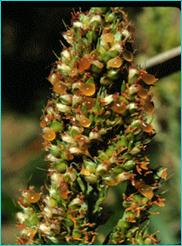 The disease is easily identified as a honeydew substance of creamy to light pinkish ooze out of the infected florets which contains numerous conidia. Within two weeks these droplets dry out as hard dark black structures larger than seeds, protruding out from the florets in place of grain, which are called sclerotia. Here the loss in grain yield is directly proportional to the percentage of infection as the infected seed is fully transformed into sclerotium. The disease occurrence and spread is highly influenced by weather conditions during the flowering time. It became more important due to cultivation of genetically uniform single-cross F1 hybrids based on cytoplasmic male-sterility system in India.

Life cycle of Claviceps fusiformis fungus (Source: ICRISAT)
Screening techniques
- Bagging panicles at the boot-leaf stage with selfing bags to allow stigma emergence in a pollen-protected environment.
- Inoculating panicles 3-4 days later by briefly opening the bags and spraying the panicles at the full protogyne stage with an aqueous conidial suspension (1x10⁶ conidia ml-1) produced from honey dew of infected panicles.
- Providing high humidity with overhead sprinklers twice a day for 30 min each at 10 am and 5 pm on rain-free days.
- Removing bags two weeks after inoculation and scoring ergot severity using a standard key
Management
- Mechanical removal of sclerotia from seed and washing of seed in 2% salt water.
- Adjust sowing dates so that ear emergence does not cocide with more rainy days.
- Plough the field soon after harvest so that ergot is buried deep.
- Three foliar application of Thiram 0.2% or Copper Oxychloride 0.25% or Ziram @ 0.2% starting from 50% flowering.

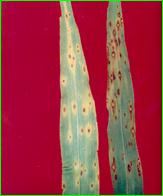 The disease is known as leaf spot of pearl millet caused by Pyricularia grisea (Cooke) Sacc [telemorph: Magnaportha grisea (Herbert) Barr.] has become a serious disease during the past few years. The disease affects both quality and production of forage and grain. The symptoms appear as distinct large, indefinite, water soaked, spindle shaped, grey centred and purple grey horizon with yellow margin, resulting in extensive chlorosis and premature drying of young leaves.